Watch the full webinar recording below.
What obligations does Canada have when Canadian-linked companies, weapons, investment and policy choices become entangled in—or even contribute to—violence abroad?
In our recent webinar, we explored Canada’s responsibility in Sudan. Canada’s policy response to the conflict was named as inadequate—from its diplomatic, humanitarian and immigration responses to its inaction on external actors fuelling the war.
Panelists Duha Elmardi (Sudan Solidarity Collective), Kelsey Gallagher (Project Ploughshares), Penelope Simons (Human Rights Research and Education Centre at the University of Ottawa) and Stuart Trew (Canadian Centre for Policy Alternatives) ultimately noted that Canada has both the responsibility and the tools to do more.
Sudan’s war did not emerge from nowhere
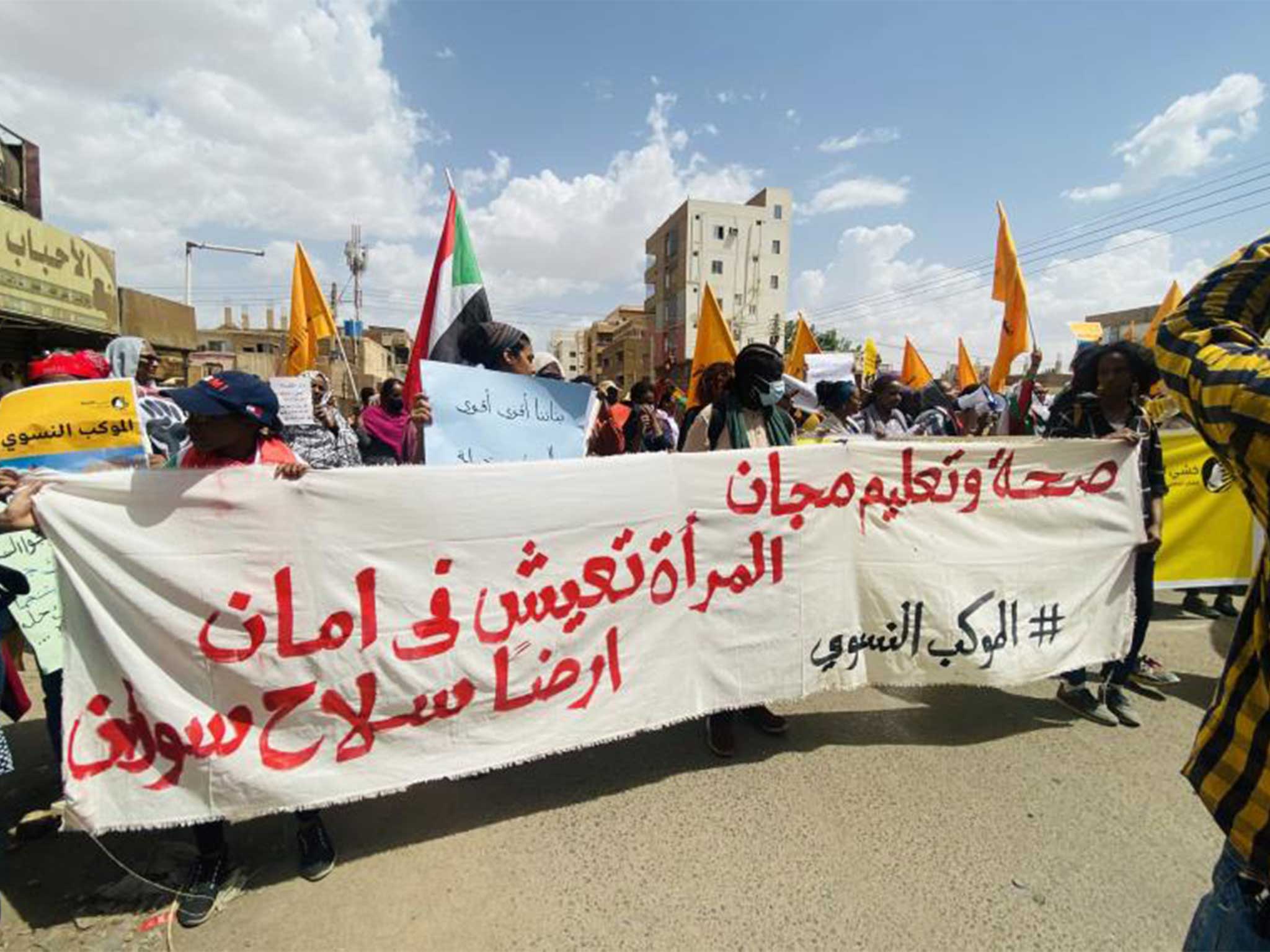
In 2019, Sudanese people led a revolution against an Islamist dictatorship. They demanded democratic civilian rule and a fundamental transformation of Sudan’s political and economic structures. These aspirations were reflected in the revolutionary charter for establishing people’s power, by Sudan’s grassroots resistance committees.
After the people toppled the dictatorship, a transition period of power sharing between civilian leadership and the military was meant to end in the establishment of a civilian government. But a joint military coup by the paramilitary Rapid Support Forces (RSF) and Sudanese Armed Forces (SAF) ended the transitional period.
The current war started when the RSF and the SAF then turned on each other in 2023.
Related: Brief | Backgrounder to the crisis in Sudan
During the transitional period, international and multilateral actors “played a counter-revolutionary role,” explained Duha Elmardi, a member of the Sudan Solidarity Collective.
“Despite publicly condemning the military coup they continued to push these negotiations and mediations and sidelined popular formations that had led the revolution,” she said.
This history coupled with Sudan’s vast resources—gold, gum arabic, agricultural land and access to the Red Sea—lay the groundwork for the current conflict.
“Control over Sudan has implications not only for Sudanese people, but also for regional trade, for food systems, for supply chains, political influence across regions,” said Duha. She added that most of Sudan’s gold goes to the United Arab Emirates, often through unofficial and illicit routes. Gold is a major driver of Sudan’s war economy.
Since 2023, ordinary Sudanese people have been carrying the weight of the humanitarian response.
“Sudan is experiencing extraordinary abandonment by the international community while also becoming a battleground for the interests of governments, corporations and empires.”
Related: Brief | Besieged areas in Sudan: Hunger, oppression and the obstruction of aid
Who is funding and fuelling the war in Sudan?
Mounting evidence has pointed to external actors fuelling the war in Sudan since the conflict started in 2023.
Most recently, an independent UN fact-finding mission documented how a transnational network has supplied the RSF with weapons, drones and logistics. In their report, investigators detailed evidence that the U.A.E. trained and financed Colombian mercenaries who massacred civilians in Darfur in October 2025. Their support for the RSF’s takeover of El-Fasher contributed to “conduct displaying hallmarks of genocide.”
During the discussion, Duha encouraged participants seeking deeper context to explore Dr. Nisrin Elamin’s research on land grabs and U.A.E. empire-making in Sudan and Husam Mahjoub’s writing on the U.A.E.’s role in Sudan and across the African continent.
Related: Canada must break its silence about the U.A.E.’s support to the RSF militia.
Canada’s role in Sudan extends beyond humanitarian aid
Many in civil society—including Inter Pares—have advocated for the appointment of a special envoy to coordinate Canada’s response in Sudan. In its official report on Sudan, Canada’s standing committee on foreign affairs and international development agreed with this idea. But, in September 2026, the government of Canada officially rejected this recommendation.
Meanwhile, Canadian weaponry has been found in the hands of militias in Sudan during the war. Kelsey Gallagher, senior researcher at Project Ploughshares dug into this during the webinar.
“Canada has sent over $60 million worth of weapons to the U.A.E. over the last five years, a country with an absolutely atrocious human rights record,” Kelsey said, noting gaps in implementation and enforcement of Canada’s export controls.
These gaps allow Canadian or Canadian-connected weapons to end up in problematic conflict contexts, through diversion and jurisdiction shopping (identifying countries with weak export control regimes and establishing parallel manufacturing centres used to supply military goods to problematic customers and evade arms embargoes).
For example, the Streit Group is an armoured vehicle manufacturer founded in Toronto by Guerman Goutorov, a Russian-Canadian citizen. Streit’s armoured vehicles—likely supplied from its manufacturing centre in the U.A.E.—have been discovered in Sudan, as reported by Global and the Globe and Mail. Similarly, CBC investigations have found a consistent pattern of British Columbia-based Sterling Cross Defense Systems’ sniper rifles in the hands of the RSF. It is generally understood that these firearms reached the RSF through an illicit pathway.
“If there’s any industry that needs to have solid human rights due diligence, it should be the arms industry,” said Kelsey.
Canada and the U.A.E.
Stuart Trew, senior researcher at the Canadian Centre for Policy Alternatives discussed Canada’s accelerating efforts to deepen links with the U.A.E.
In mid-2026, a free trade agreement with the Emirates was concluded in record time, despite widely raised concerns over the country’s role in Sudan. In October, Canada’s government went several steps further, announcing a plan to elevate the Canada-U.A.E. relationship to a “strategic partnership” and signed a defence cooperation pact, which will include a joint military committee and “professional military exchanges.”
And despite the U.A.E.’s record of unlawful detentions and suppression of basic human rights at home, Canada agreed to begin talks to sign an extradition treaty.
When the free trade agreement comes to a parliamentary vote, Canada could use it as leverage to put pressure on the U.A.E.
“I think MPs should vote against the agreement on humanitarian grounds […] It would be a good signal that we put human rights and international law above the limited interests of a handful of Canadian exporters,” Stuart said.
He questioned the value of the trade deal; while the agreement would lower tariffs on Canadian exports to the Emirates, tariffs are already quite low. Stopping the trade deal would not harm the Canadian economy.
“So, it’s not quite a nothing burger, but it’s not far off as far as these things go.”
Canadian corporate interests and Sudan: History repeats itself
“This is not the first time that Canadian companies have been implicated in conflict and violations of human rights in Sudan,” said Penelope Simons, director of the University of Ottawa’s Human Rights Research and Education Centre.
In 1999, Penelope was part of the Harker mission, an independent fact-finding mission tasked by then-foreign minister Lloyd Axworthy to investigate Canadian corporate wrongdoing in Sudan. The mission found that the Sudanese government was using infrastructure belonging to Talisman Energy, a Canadian oil company, to launch bomber raids against civilians.
But the Canadian government said it had no tools to hold Talisman accountable. Lacking domestic laws and mechanisms to regulate transnational corporate conduct, Canada has long relied on corporations to self-regulate. But the Harker mission experience showed self-regulation doesn’t work.
“We should be requiring companies to engage in mandatory human rights due diligence in relation to their activities—their sales of weapons for example,” Penelope argued, noting many countries have adopted mandatory human rights due diligence laws.
“There’s no reason Canada can’t do it. It’s absolutely feasible.”
Related: Canada should re-establish the Canadian Ombudsperson for Responsible Enterprise (or similar body), with power to investigate claims of corporate wrongdoing.
What must Canada do on Sudan
Here are the panelists’ proposals for Canadian action on Sudan, as outlined in moderator Steven Staples’ summary of the conversation:
- Expand the embargo. Canada should call on the UN Security Council to extend the arms embargo from Darfur to all of Sudan, as the UN mission recommends.
- Track weapons after they leave. Adopt post-shipment checks, as Germany, Switzerland and the U.S. do, and enforce brokering controls on Canadian-owned firms producing abroad.
- Review arms sales to the U.A.E. Canada has sold the U.A.E. over $60 million in weapons in five years.
- Make human rights due diligence mandatory. Require companies to identify and prevent human rights harms, give victims the right to sue in Canada, and restore a corporate ombudsperson with real investigative powers.
- Vote down the U.A.E. trade deal and end the investment treaty, or at minimum conduct a human rights impact assessment before ratification.
- Appoint a special envoy for Sudan to pull Canada’s scattered response together.
Actions you can take
- Keep talking about Sudan. For the largest humanitarian crisis in the world, Sudan’s footprint in the media is small. It’s up to people like you to keep Sudan in hearts and on minds—and on the political agenda.
- Demand Canada cut ties with the U.A.E. Send an email to Prime Minister Carney, key ministers and your MP to demand an immediate halt to the Canada-U.A.E. trade deal, an arms embargo on the U.A.E. and freedom for Sudan.
- Keep pushing the Canadian government to appoint a special envoy for Sudan and to pressure the U.A.E. to stop aiding and abetting war crimes in Sudan. Send Minister Anita Anand an email now.
WATCH THE RECORDING
This conversation was recorded on October 1, 2026. The conversation was moderated by Steven Staples, with an introduction by Rita Morbia of Inter Pares.
About the panelists
Duha Elmardi
Duha is a Sudanese organizer currently based in Tiohtiàke/Montreal. She is a member of the Sudan Solidarity Collective and supports a number of groups and organizations working towards social and climate justice.
Kelsey Gallagher
Kelsey is a Senior Researcher with Project Ploughshares, where he focuses on conventional arms control and the Canadian arms trade. He monitors the transfer of weapons and their use in conflicts abroad, as well as export control policy and transparency.
Rita Morbia (she/her)
Rita has worked with Inter Pares for over 25 years on a range of issues related to women’s rights, and feminist movement-building. Currently, she works with activists in the Philippines and Sudan on bodily autonomy and women’s political participation respectively.
Penelope Simons
Penelope is a Full Professor at the Faculty of Common Law, University of Ottawa and the Director of the Human Rights Research and Education Centre. A global leader in business and human rights, her research focuses on the human rights implications of domestic and transnational extractive sector activity, state responsibility for corporate complicity in human rights violations, the regulation of transnational corporations, gender and resource extraction, gender and business and human rights, as well as the intersections between transnational corporate activity, human rights and international economic law.
Steven Staples
Steven is an accomplished policy advocate, communicator and author with deep roots in many social movements, especially for peace and international cooperation. In 2006, he founded the Rideau Institute on International Affairs. Today, he promotes public health care through the Canadian Health Coalition, and promotes peace education through his weekly PeaceQuest columns on Substack.
Stuart Trew
Stuart is a senior researcher at the Canadian Centre for Policy Alternatives where he directs the centre’s Trade and Investment Research Project.
Inter Pares co-hosted the conversation alongside the Sudan Working Group of the Women, Peace and Security Network – Canada (WPSN-C), the Sudan Solidarity Collective, Project Ploughshares and the Canadian Centre for Policy Alternatives (CCPA).